Concrete does not care what your builder's schedule looks like. It cures on its own terms, and those terms are set by temperature, moisture and time. On the Northern Rivers, the weather swings hard between a wet, hot summer and a mild, dry winter, and picking the wrong month can mean surface damage, slow strength gain, or a pour that gets rained out before it sets.
The short version
- Bureau of Meteorology station 058158 at Murwillumbah records 180.2 mm in February and just 45.5 mm in July. The driest stretch is July to September.
- Mean daily maximum temperatures range from 19.9 degrees in July to 28.1 degrees in January. Concrete needs a minimum of 15 degrees to cure properly under AS 3600.
- Rain falling on fresh concrete within two to four hours of placement can pit, scale and weaken the surface beyond repair.
- July, August and September give the best combination of low rainfall, fewer rain days, and moderate temperatures for pouring and curing.
- Driveway crossover works in the Tweed Shire road reserve require Section 138 consent under the Roads Act 1993 before any concrete is placed.
What the rainfall record says about timing
The Bureau of Meteorology station at Murwillumbah (Bray Park), station 058158, has decades of monthly data. The numbers paint a clear picture of when the rain arrives and when it backs off.
February is the wettest month at 180.2 mm, followed by January at 160.9 mm and December at 142.3 mm. March brings 130.6 mm. Those four months alone account for more than 600 mm of rain, and each one averages between 12 and 14 rain days.
At the other end, July averages just 45.5 mm across 8.9 rain days. August sits at 51.2 mm across 9.1 days. September is the driest month of all at 48.4 mm and only 8.0 rain days. Those three months together bring less rain than February does on its own.
For anyone planning a concrete driveway or a house slab or shed slab, that gap matters. A pour needs a dry window not just for placement day but for several days afterward while the surface hardens.
Why rain on fresh concrete is not just an inconvenience
Concrete gains its strength through a chemical reaction between cement and water, called hydration. The mix is designed with a specific water to cement ratio. When rain lands on concrete in the first two to four hours after placement, it adds water the mix was never meant to carry.
Light rain on a slab that has already been finished and is starting to firm up is usually manageable. Heavy rain on concrete that has just been screeded and has not yet been floated or trowelled is a different story. The extra water dilutes the paste at the surface. It washes out fine particles. It leaves pitting, scaling and a weak top layer that dusts and flakes once the slab is in service.
The damage sits right where you walk on it, drive on it, or look at it every day. A weak surface layer on a decorative exposed aggregate finish is visible for the life of the slab. On a plain grey driveway it shows as patchy discolouration and surface dust within the first year.
None of that is repairable by grinding or coating. The only fix is to break it out and pour again, which costs more than doing it once in the right conditions.
What counts as "fresh" concrete
The risk window depends on the mix, the air temperature and the wind. In cool, still conditions a slab can stay vulnerable for four hours or more. In the heat of a Northern Rivers January, initial set can come faster, but the surface also dries unevenly and is more prone to plastic cracking. Neither extreme is ideal. Moderate conditions, the kind July through September reliably delivers, give the finishers time to work without racing the weather.
Temperature and curing: what AS 3600 requires
Australian Standard AS 3600 (Concrete Structures) sets out the rules for curing. Concrete needs a minimum of seven days at above 15 degrees Celsius to reach its design strength. If the temperature drops below that threshold, the hydration reaction slows and the concrete takes longer to reach full strength.
Look at the monthly mean maximum temperatures from station 058158. July averages 19.9 degrees, August 20.9 degrees, and September 22.9 degrees. All three sit comfortably above the 15 degree minimum. Even overnight lows on the Northern Rivers rarely dip below 10 degrees in winter, so the curing reaction keeps ticking around the clock.
January and February average 28.1 and 27.7 degrees. That is well above the minimum, but high heat brings its own problems. Rapid moisture loss from the surface causes plastic shrinkage cracking. The finishers have less working time. And the concrete sets faster than the crew can keep up with on a large pour, which is a real issue on a full house slab or a long driveway.
The sweet spot for temperature
Somewhere between 15 and 25 degrees is where concrete behaves best. The reaction proceeds at a steady rate. The surface does not dry out before the finishers can close it. And the crew can work without heat stress, which matters when you are screeding and floating for hours on end. August at 20.9 degrees and September at 22.9 degrees land right in that range.
Month by month: a local pouring calendar
Here is how each month stacks up for concrete work on the Northern Rivers, based on the BoM averages from station 058158.
January to March: hardest months to pour
January brings 160.9 mm across 13.1 rain days at a mean maximum of 28.1 degrees. February is the wettest month at 180.2 mm and 14.0 rain days. March records 130.6 mm and 14.4 rain days, the highest rain day count of any month despite not being the wettest.
The combination of heavy rainfall, high humidity and temperatures above 27 degrees makes this the worst quarter for concrete. Rain risk is high on any given day, and when rain does hold off the heat accelerates surface drying and cuts working time. Pours are possible, but they require close weather monitoring and often get pushed back.
April to June: improving but unpredictable
April drops to 83.0 mm and 12.0 rain days at 24.7 degrees. May and June sit at 94.2 mm and 94.7 mm. Temperatures ease into the low twenties. Conditions are better than summer, but the tail end of the wet season can still deliver multi-day rain events that delay formwork preparation and pour schedules.
July to September: the best window
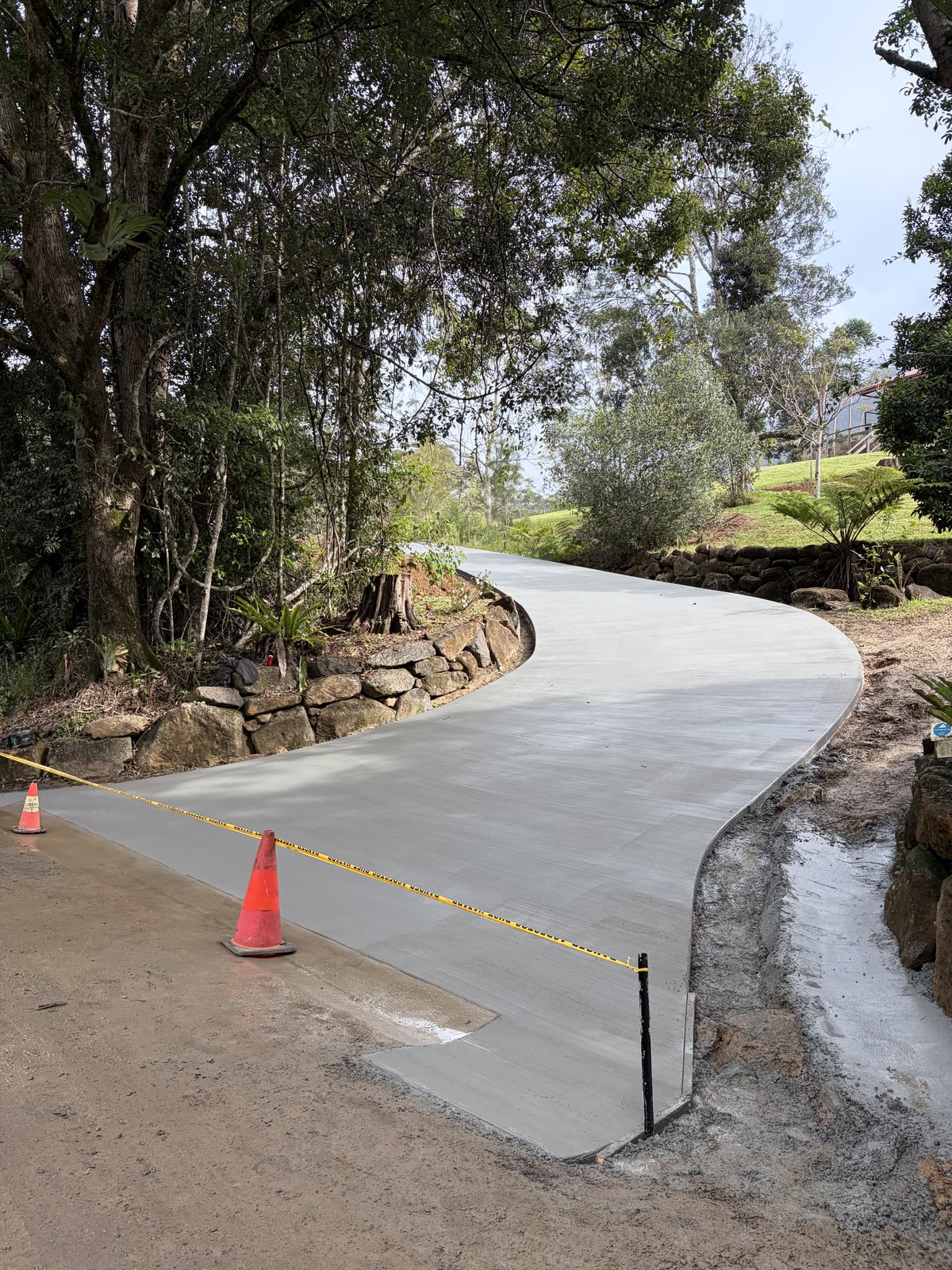
July averages 45.5 mm across 8.9 rain days at 19.9 degrees. August brings 51.2 mm and 9.1 rain days at 20.9 degrees. September is the standout at 48.4 mm and just 8.0 rain days at 22.9 degrees. These three months offer the lowest rainfall, fewest rain days, and temperatures right in the ideal curing range. This is when most concreters on the Northern Rivers prefer to schedule their bigger jobs, and it is when we do the bulk of our pool surrounds and large slab work.
If you are in Tweed Heads, Kingscliff, Murwillumbah or Pottsville, this is the window to book.
October to December: the rain returns
October climbs back to 92.9 mm and 10.8 rain days. November hits 110.3 mm and December reaches 142.3 mm. Temperatures rise through the mid to high twenties. The storm season is building. Pours are still workable in October and early November, but by December you are back in summer territory with high rain risk and heat.
Council approvals: what to sort before you book a pour
If your concrete job involves a driveway crossover, which is the section between the property boundary and the road, you need approval before any concrete goes down. Tweed Shire Council requires Section 138 consent under the Roads Act 1993 for any works in the road reserve. That includes new crossovers, widening existing ones, and in many cases resurfacing them.
The approval process takes time. If you are planning a new driveway in Tweed Heads or Springbrook, start the paperwork well before your preferred pour date. Getting the consent sorted in May or June means you can pour the crossover during the dry July to September window without delays.
Work inside your property boundary, such as a shed slab, a pool surround, or a patio, generally does not need a road reserve approval. But it may still need a development approval or a complying development certificate depending on the size and location. Check with Council or your certifier early.
How to protect a pour when rain is forecast
Even in the dry months, rain can arrive. The Northern Rivers is not a desert. Here is what a well run pour looks like when there is some chance of weather.
The BoM forecast is checked the morning of the pour and again at the truck dispatch call. If there is a high chance of rain within six hours, the pour is pushed. A day lost to a postponement costs nothing compared to a slab that has to be broken out.
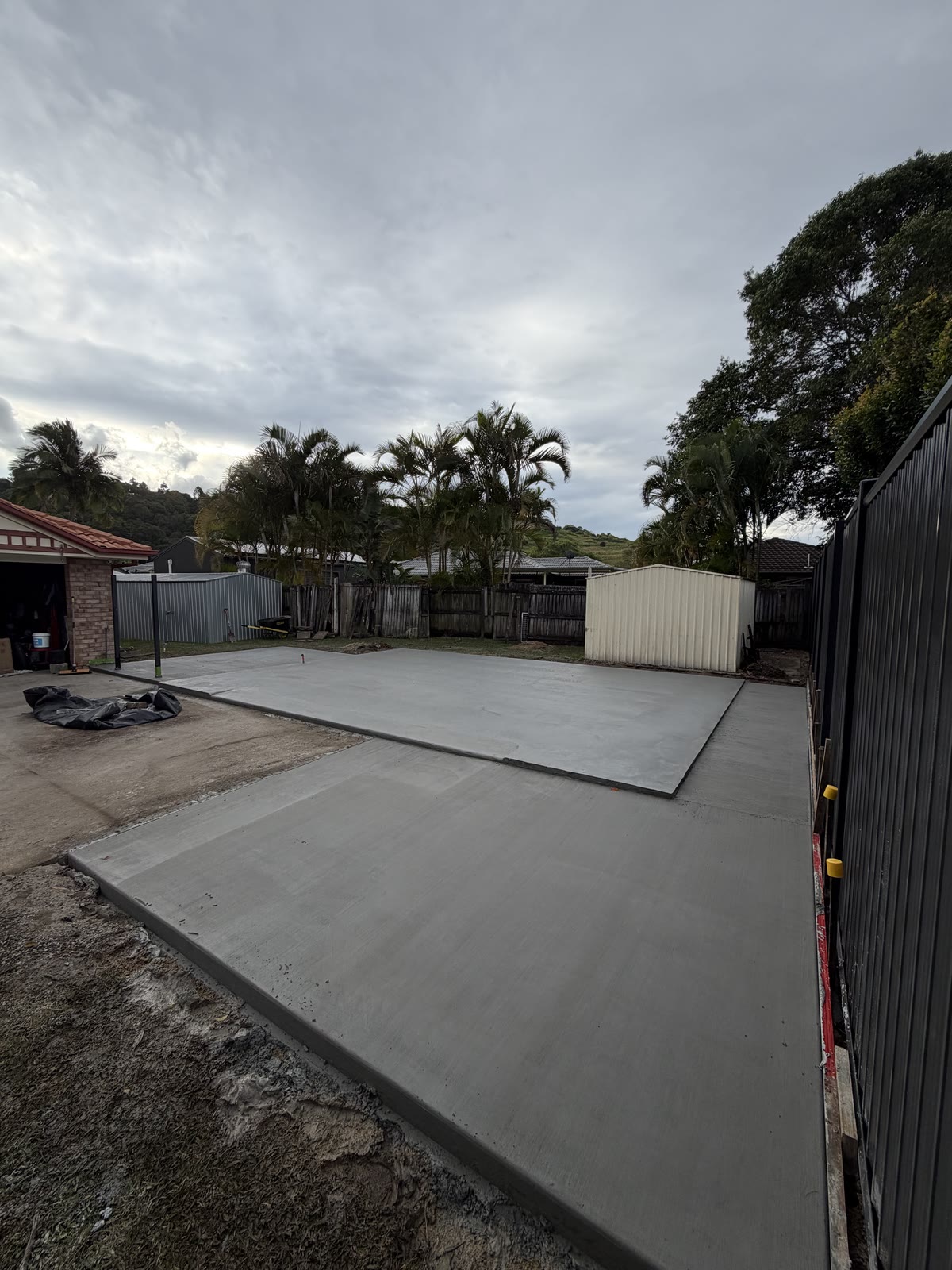
On days where there is a low chance of a passing shower, plastic sheeting is on site and ready to go. If rain arrives after the concrete has been placed and bull floated but before final finishing, the sheets go over the slab immediately. They must not touch the surface, so they sit on a frame or on formwork edges. Laying plastic directly on wet concrete traps bleed water and leaves marks.
After the surface has been finished and has firmed enough to resist indentation, curing compound goes on. Curing compound seals the surface and slows moisture loss, which is the whole point of curing. It also gives some protection against light rain that arrives overnight.
What happens during the seven day cure
Concrete does not reach full strength the day it is poured. It reaches about 70 per cent of its 28 day design strength by day seven, and the first week is when it is most vulnerable. During those seven days the slab needs to stay moist and above 15 degrees.
On the Northern Rivers in winter, temperature is not the concern. Moisture retention is. The air is drier in July and August than in summer, and a slab left uncured in a dry westerly wind can lose surface moisture faster than the hydration reaction can use it. That is why curing compound or wet hessian is standard, not optional.
During the cure period, no vehicles, no heavy loads, no dragging anything across the surface. A driveway slab should not see a car for at least seven days, and heavy vehicles like a loaded trailer or a skip bin truck should wait longer. We mark these timelines clearly on every job so there is no guesswork.
If you are in the Murwillumbah or Kingscliff area and planning around a house build, coordinate the pour date with your builder so nobody is driving over a slab that has not reached strength.
Planning your project around the weather
The best time to start planning a concrete project on the Northern Rivers is three to four months before you want the pour to happen. That gives time for site preparation, formwork, any required approvals, and booking a slot with the batch plant and the crew.
If you want to pour in August or September, start the conversation in May. That is enough lead time to get a site inspection done, sort the levels, confirm the mix design, and lock in a date. Leaving it until July means you are competing with everyone else who looked at the same BoM data and reached the same conclusion.
All Concrete Creations works across the Northern Rivers from Tweed Heads to Springbrook, Pottsville to Murwillumbah. We pour driveways, house and shed slabs, pool surrounds, and exposed and architectural concrete.
If you have a project in mind, get in touch and tell us what you are building, where the site is, and when you want to pour. We will tell you what the site needs, what the weather is likely to do, and what it will cost.